

Workflows
Design modular task execution pipelines on a drag-and-drop canvas with automated validation, review loops, plugin pathways, and strict edge connection rules.
Overview
Workflows define how tasks move sequentially or conditionally through annotation, quality assurance review, plugin execution, and completion. Navigate to Workflows in the left sidebar to build and manage flow graphs.
Workflow Node Types
Every workflow is constructed from five distinct node types:
Start Node
Entry point of the pipeline. All newly generated tasks begin here. Exactly one outgoing edge.
Annotation Node
Human annotation stage where annotators complete labeling tasks. Exactly one outgoing edge.
Review Node
Quality assurance gate where QC reviewers evaluate submissions. Exactly two outgoing edges: approve and reject.
Plugin Node
External automated ML or heuristic processing. One or more outgoing edges, each mapped to a unique Pathway ID.
Complete Node
Terminal node. Tasks reaching this node are locked, verified, and complete. Zero outgoing edges.
Guide: Creating a Workflow
Step-by-Step Guide
Navigate to Workflows and click Create Workflow
Click Workflows in the left navigation and click the blue Create Workflow button.
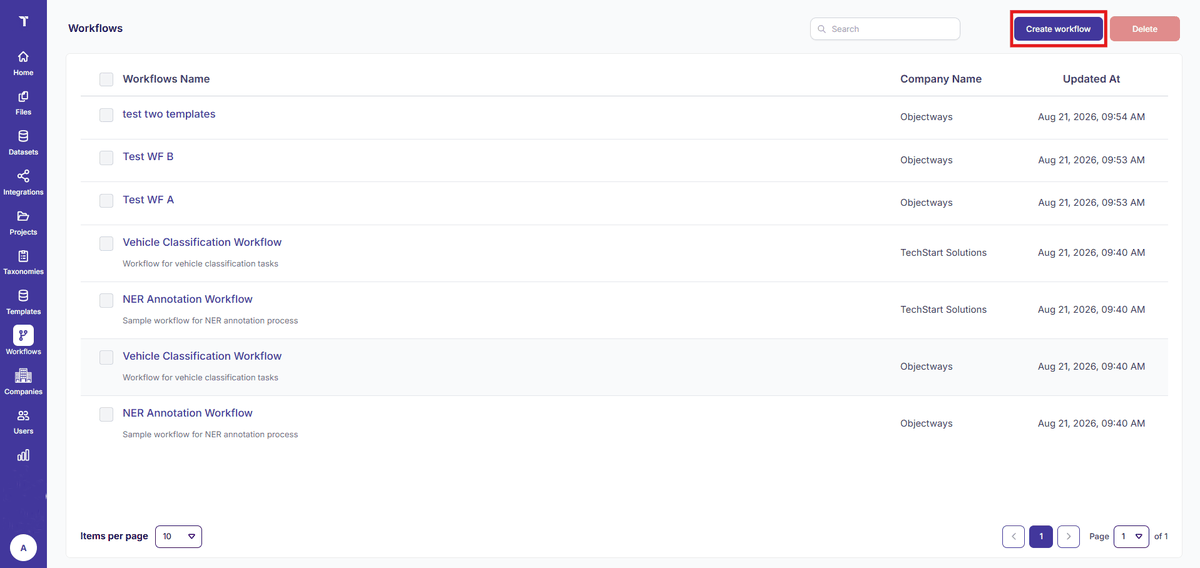
Figure 51: Create Workflow Page
Configure workflow name and template
Enter a unique Workflow Name, optional Description, and select a starter template: Blank Workflow, Annotation & Review, or Assisted Annotation.
Add START node
Drag a START node from the Node Library onto the visual canvas.
Add ANNOTATE node and connect
Drag an ANNOTATE node onto the canvas and connect the outgoing handle of the START node to the input of ANNOTATE.
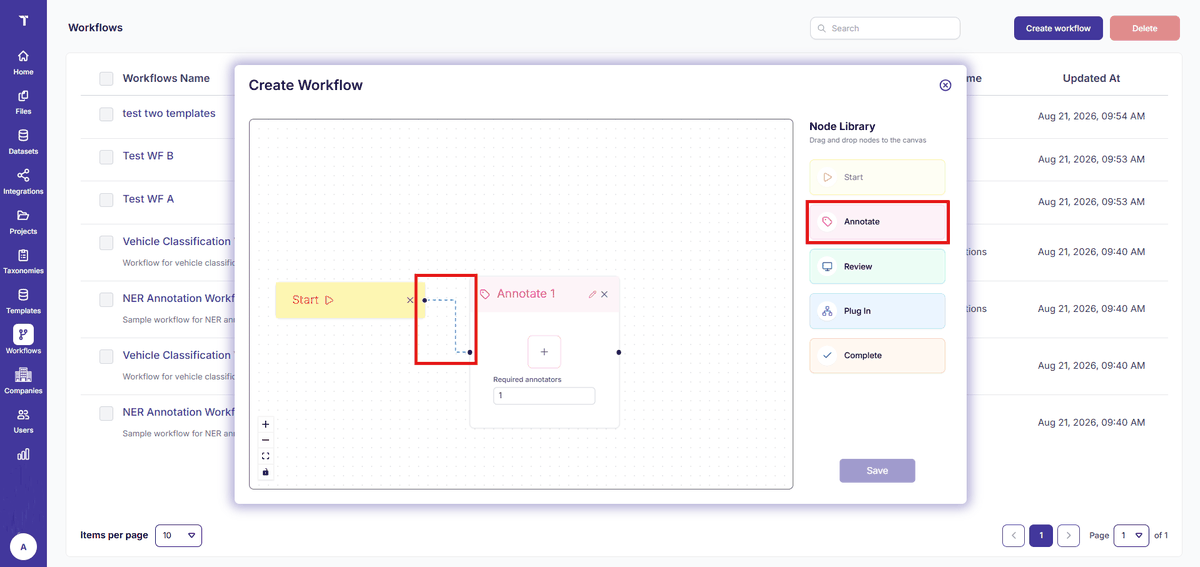
Figure 52: Workflow - Annotate Node
Add REVIEW node and connect
Drag a REVIEW node onto the canvas and connect the outgoing handle of ANNOTATE to REVIEW.
Add COMPLETE node and connect approval/rejection paths
Add a COMPLETE node. Connect the REVIEW node's Approve path to COMPLETE, and its Reject path back to the ANNOTATION node.
Assign Pathway IDs (for Plugin nodes)
If using PLUGIN nodes, assign a distinct Pathway ID to each outgoing branch (e.g.
confident, needs_review, escalate).
Validate and Save
Click the Validate button to run the automatic rule checker. Once passed, click Save to publish.
Managing Workflows
- Edit Workflows: You must remove a workflow association from any active project before modifying its node architecture.
- Delete Workflows: Only workflows not actively linked to any existing project can be deleted.
Workflow Validation Rules
- START and ANNOTATION nodes must have exactly one outgoing edge.
- REVIEW nodes must have exactly two outgoing edges (one approve path and one reject path).
- PLUGIN nodes must have at least one outgoing edge, each designated with a unique Pathway ID.
- COMPLETE nodes are terminal and must have zero outgoing edges.
- All non-terminal nodes must have at least one outgoing edge (no dead ends).