

Projects and Task Management
Discover the core production workspace in Tensoract where datasets, labeling templates, routing workflows, taxonomies, and cross-functional teams intersect to power high-throughput data operations.
Overview
Projects are the core workspaces in Tensoract where datasets, workflows, team members, and taxonomies are combined to accomplish annotation goals.
Prerequisites for Creating a Project
Before initializing a project, verify that the following three foundational components have been configured:
- Templates: At least one validated, published annotation template must exist (see Section 10).
- Workflows: A workflow utilizing that template must be published (see Section 9).
- Datasets: At least one dataset populated with media files must exist (see Section 4).
Guide: Creating and Configuring a Project
Step-by-Step Guide
Navigate to Projects and click Create Project
Click Projects in the sidebar, then click the blue Create Project button.
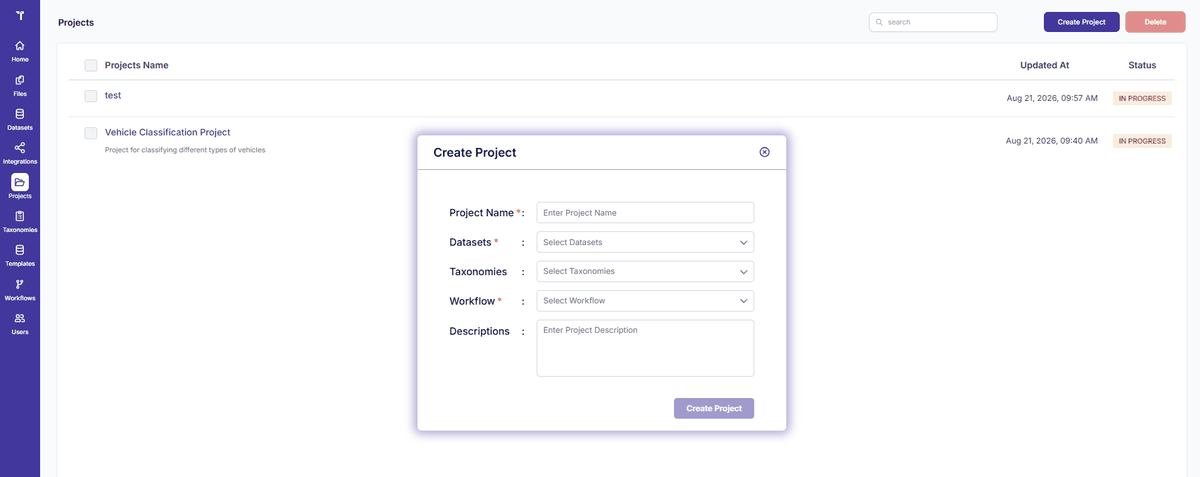
Figure 40: Create Project Page
Set Project Name and Description
Provide a project identifier and summary of labeling objectives.
Link Datasets
In the Datasets section, select one or more datasets. Every individual file contained within these datasets is converted into an annotation task.
Attach Taxonomy
Attach a predefined taxonomy schema to define routing classifications and metadata classes (see Section 8).
Attach Workflow
Connect a workflow pipeline to define the exact node stages (Annotation, Review, Plugins, Completion).
Click Create Project
The project workspace is created and queued for task generation.
Assign Team Members
Open the project, switch to the Teams tab, click Add Users, and assign specific project roles (Annotator, Reviewer, Project Supervisor).
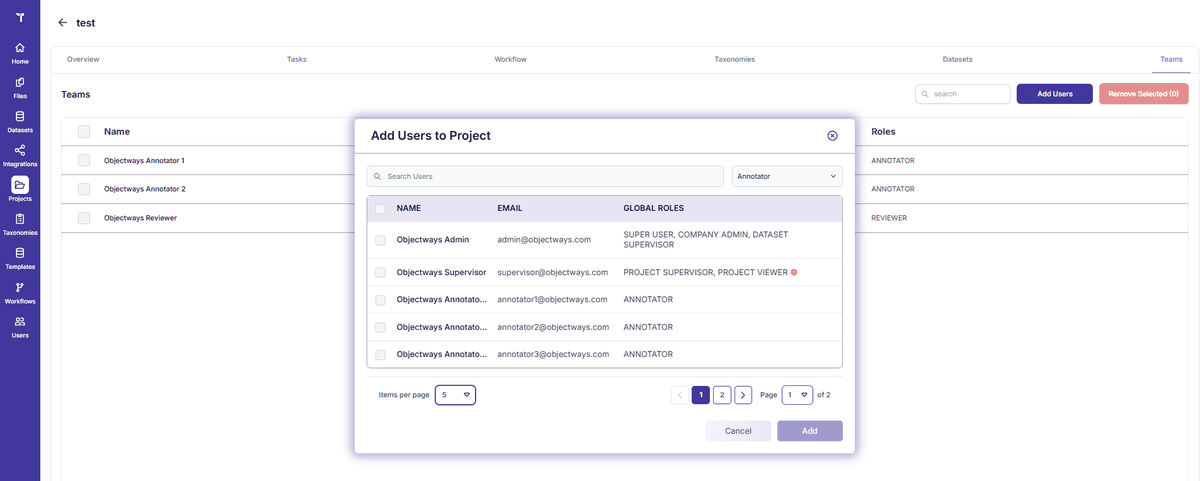
Figure 41: Project - Teams Tab
Guide: Managing an Existing Project
- Adding & Syncing Datasets: Go to the Datasets tab within your project. You can link
additional datasets or click Sync on an existing dataset to generate tasks for any new
files recently uploaded to it.
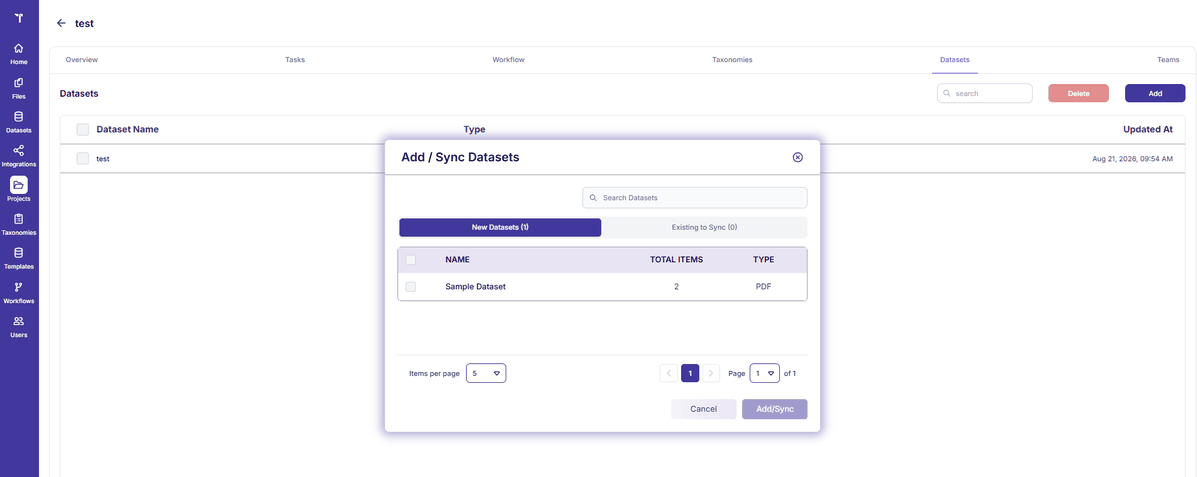
Figure 42: Project - Datasets Tab (Sync)
- Removing Datasets: From the Datasets tab, you can remove a dataset if it is no longer
required. Warning: Removing a dataset also deletes all tasks associated with that dataset from the
project. Ensure required annotations are exported first!
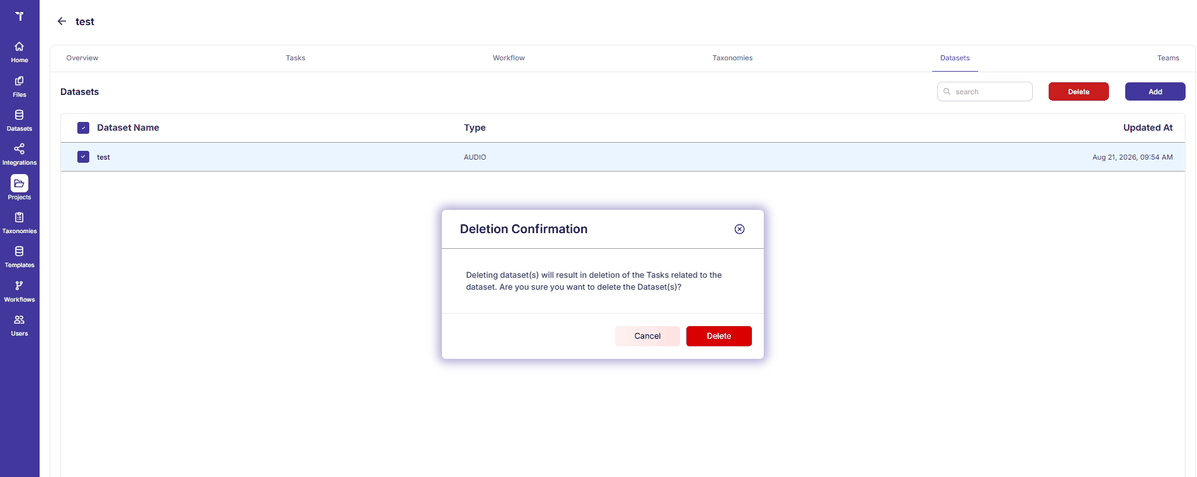
Figure 43: Project - Datasets Tab (Remove)
- Updating Taxonomies: Go to the Taxonomies tab to attach additional taxonomies or update existing schemas as project requirements evolve.
- Managing Team Members: Navigate to the Teams tab to add new team members, adjust roles (e.g. promote Annotator to Reviewer), or revoke access.
Task Generation and Assignment
- Task Generation: Each file in a linked dataset automatically becomes one task within the project.
- Task Queues: Annotators and Reviewers see their assigned projects when logged in. They can pick up claimed tasks or pull fresh tasks from the general queue.
- Deep Linking: Each task generates a unique, permanent URL for instant sharing and expedited supervisor debugging.
- Quorum Annotation: A project can require multiple annotators to independently label and submit the same task before it advances to review. All participant submissions are recorded and compared.
Task Lifecycle and Actions
Tasks transition dynamically between states based on human decisions and plugin outputs:
- Submit / Approve: Annotators submit completed work (advancing state to
REVIEW). Reviewers inspect work and click Approve to mark the taskCOMPLETED. - Reject: Reviewers reject low-quality work back to the Annotator (state changes to
REJECTED). A rejection comment is mandatory and visible to the original annotator. - Decline: Annotators or Reviewers decline unworkable tasks (e.g., corrupt audio,
obscured imagery). The state becomes
DECLINED, requiring a documented reason. - Reset: Project Supervisors can reset any task back to its initial
STARTstate. - Task Messaging: Users can post threaded comments directly inside any task for
organized peer discussions.
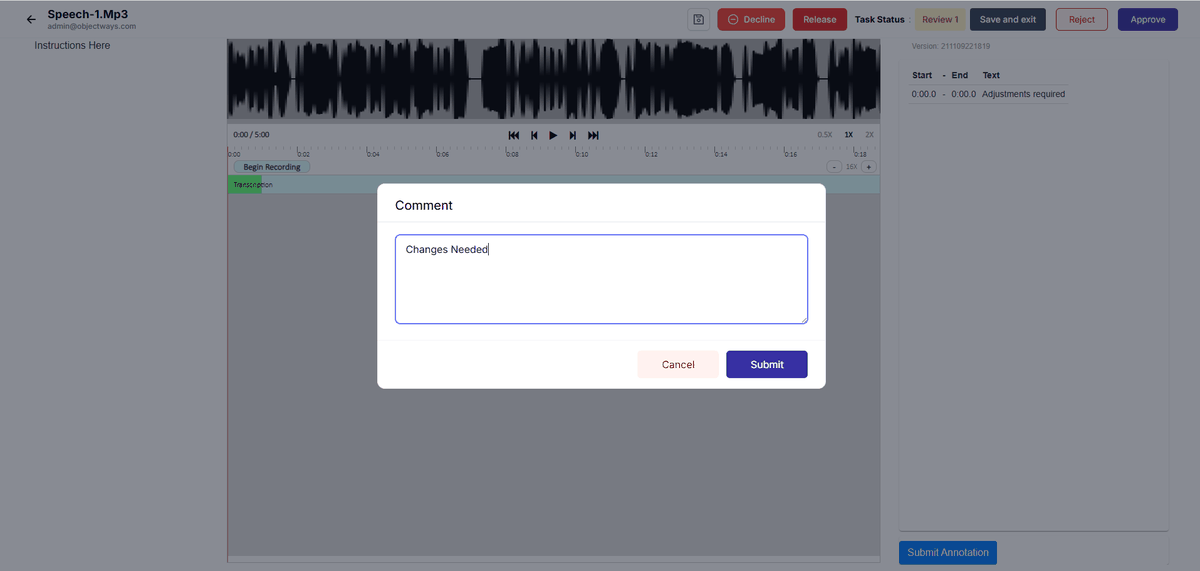
Figure 44: Task - Comment Dialog
Lock and Release
To prevent duplicate concurrent work, each task can only be actively worked on by one user at a time (exclusive lock). Tasks are automatically locked to a user when opened/claimed and released when submitted, rejected, or exited manually.
Complete Task State Reference
Task generated from dataset file, but has not yet been opened by any user.
Available for an annotator to claim, or currently being actively annotated.
The annotator has submitted the task for review. Awaiting review or under active QC inspection.
Reviewer rejected the task. Returned to the original Annotator for corrections.
Reviewer approved the submission. Task is locked and ready for downstream export.
Awaiting external automated machine-learning processing or heuristic pipeline.
Declined by an annotator or reviewer as unworkable. A decline reason is recorded.
Plugin Integrations (Automated Processing)
- Local Execution Required: You must run an external Python worker script on your local workstation or server to pull tasks, invoke local/remote models, and push results back to Tensoract.
- Pre-labelling: Send raw tasks to an external ML model to generate pre-annotations before human verification.
- Pathway ID Routing: When a plugin finishes processing, it returns a
pathwayIdthat maps to a specific outgoing edge of the PLUGIN workflow node. This routes the task dynamically (e.g., confident predictions route toCOMPLETE, uncertain ones route toANNOTATE).
Project Monitoring
Step-by-Step Guide for Tracking Project Progress
Open Project Dashboard
Click on your project name from the Projects directory.
Inspect Status Overview
The Overview tab displays real-time counters for total tasks across all states: Annotate, Submitted for Review, Completed, and Declined.
Track Productivity & Time Intervals
Scroll down to view the Annotator Summary and Reviewer Summary tables. The platform logs precise working time intervals per task to calculate throughput, acceptance rates, and accurate billing hours.
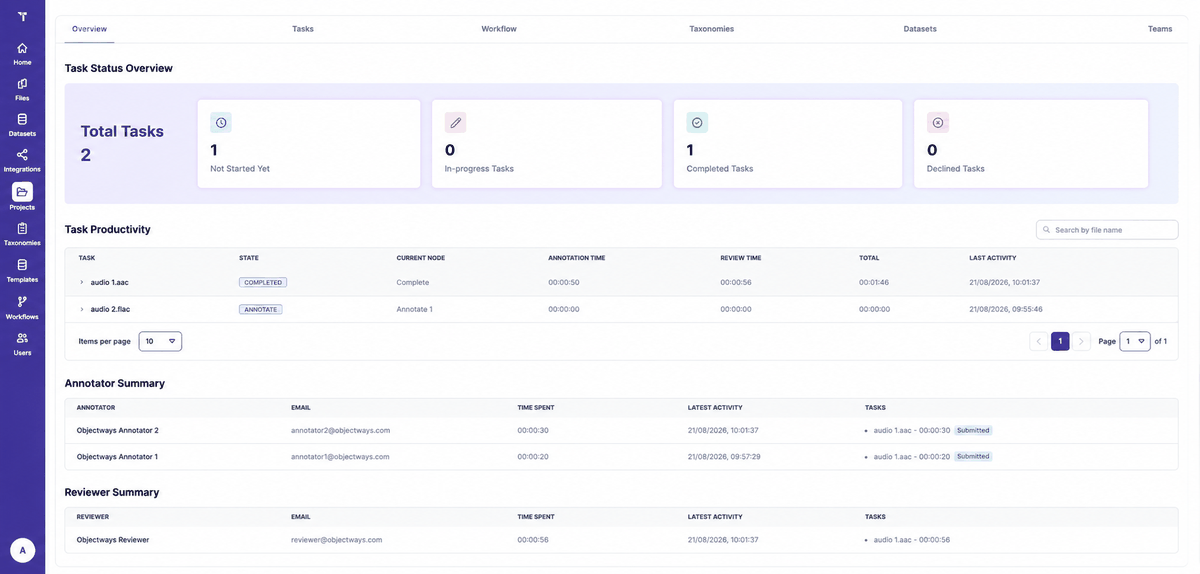
Figure 45: Project - Time Tracking
Exporting Results
Export completed annotations and audit logs from your project at any time. Supported output formats include standard JSON with full label coordinates, timestamps, and annotator metadata.